Sleep Apnea is a dangerous condition that affects over 1 million Australians
The good news is that it's easily diagnosed and treated in your home, in your bed, and with your pillow.
Step 1
Complete a FREE Sleep Consult with your CPAP Ipswich Sleep Team Specialist who will provide you with a Sleep Referral Form for your GP to complete and return to us.
Step 2
We will then book a time for you to be set up with your FREE* In-Home Sleep Test. Once complete, you return the Monitoring Device to us the following morning.
Step 3
Your results are analysed by a Specialist Sleep Doctor. Your Sleep Team Specialist will contact you as soon as they are available and will recommend treatment as required.
Good Sleep
Poor Sleep
What is Obstructive Sleep Apnea?
How common is Obstructive Sleep Apnea?
Obstructive Sleep Apnea (OSA) is a common medical condition. It affects about 1 in 20 adults. It is most common in middle-aged men, in fact 1 in 10 men aged 45 years or over have this medical condition. It also frequently occurs in women aged 65 and over.
What are the warning signs?
If you have OSA you may not be aware that you stop breathing while you are sleeping. Quite often, it will be your partner, family or friends who notice the symptoms first. Some common symptoms may include:
- Waking up in the morning with headaches
- Memory or learning problems and not being able to concentrate
- Feeling irritable, depressed, having mood swings or personality changes
- Falling asleep while working, reading, or watching TV
- Feeling sleepy while driving, or even falling asleep while driving
- Waking up frequently to urinate
- Dry mouth or sore throat when you wake up.
How is OSA diagnosed?
The good news is that OSA can be diagnosed and managed by your doctor. Successful treatment can improve your sleep, reduce daytime drowsiness, and improve your quality of life. It can also lower your blood pressure and improve your heart health. OSA can range from mild to severe and may not always need treatment.
Before any treatment is considered, your doctor will organise a sleep study to determine how severe your OSA is. A sleep study can be carried out in either a Hospital sleep laboratory or in the comfort of your own home. Your doctor will explain how this can be done.
What are the treatment options for OSA?
The most common treatment is Continuous Positive Airway Pressure (CPAP). The CPAP device provides a gentle flow of air to keep your airway open while you are sleeping, preventing pauses in breathing.
All clear for the "Airways"
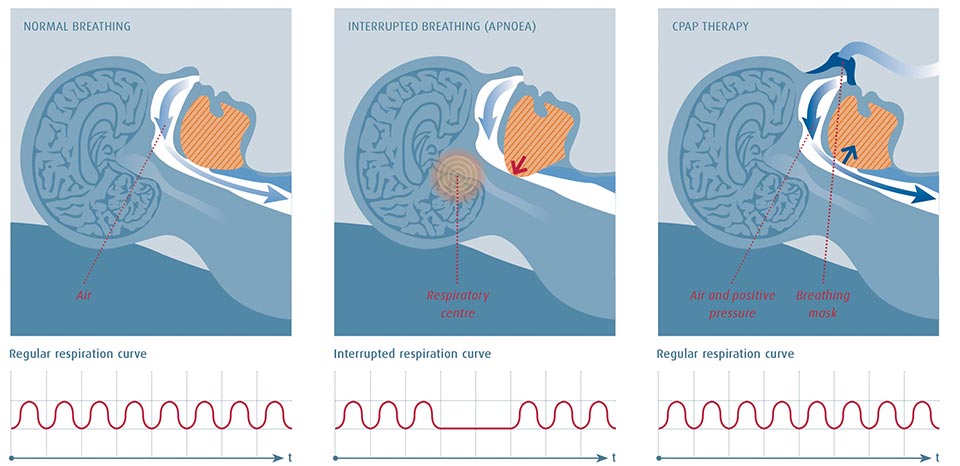
Healthy people inhale air into their bodies without any restrictions (above left). If, however, the muscles in the palate and throat relax, they can block the airway and interrupt breathing. These dangerous pauses are known as apnea episodes (above middle).
The body no longer receives sufficient oxygen, which causes the respiratory centre to send a wake-up call. During CPAP therapy (above right), a continual supply of air is pumped into a patient's throat via a mask. This creates positive air pressure that keeps the airways free.
*eligibility criteria applies.